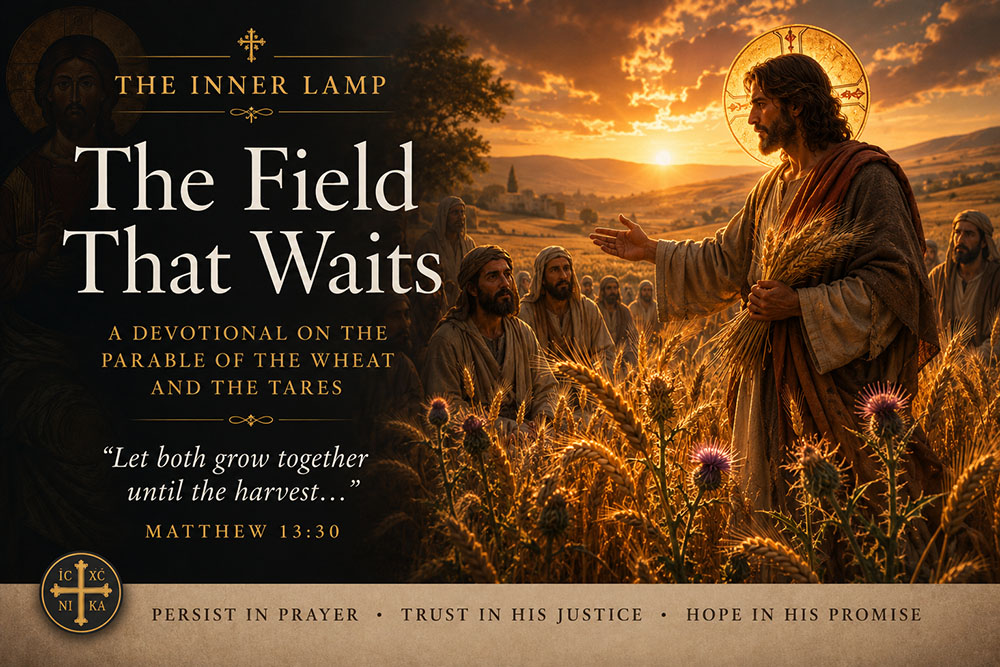
A Lenten Devotional on the Wheat and the Tares
Gospel of Matthew 13:24–30
Another parable He put forth to them, saying: “The kingdom of heaven is like a man who sowed good seed in his field; but while men slept, his enemy came and sowed tares among the wheat and went his way. But when the grain had sprouted and produced a crop, then the tares also appeared.
So the servants of the owner came and said to him, ‘Sir, did you not sow good seed in your field? How then does it have tares?’
He said to them, ‘An enemy has done this.’
The servants said to him, ‘Do you want us then to go and gather them up?’
But he said, ‘No, lest while you gather up the tares you also uproot the wheat with them. Let both grow together until the harvest…’”
Patristic Insight
John Chrysostom understood this parable as a warning against spiritual arrogance and premature judgment. Christ does not deny the presence of evil in the world, nor even within the visible life of the Church. Rather, He reveals the patience of God, who delays judgment so that repentance may still occur.
Chrysostom notes that some who appear corrupt may yet change, while some who appear righteous may later fall through pride. The field remains under the care of the Master, even when the servants cannot yet distinguish all things rightly.
The Lord’s restraint is not weakness. It is mercy.
Meditation
There is something deeply uncomfortable about a field left unresolved.
We prefer immediate separation. We want the clean distinction now—the righteous clearly visible, the corrupt exposed without ambiguity. Yet Christ tells a different story. The wheat and the tares grow together beneath the same sky, nourished by the same rain, rooted in the same ground. The disorder is not corrected at once.
Instead, it is endured.
The servants are troubled by this. Their question is understandable: If the seed was good, why is there corruption in the field at all? It is the same question that rises within every generation of believers. Why does sin remain so near to holiness? Why does darkness linger so close to the sanctuary? Why does the human heart remain divided even after encountering God?
The answer Christ gives is sobering because it refuses simplicity.
An enemy has done this.
The Lord acknowledges both realities at once: the goodness of the field’s original planting and the genuine presence of evil within it. Christianity does not deny the existence of corruption, nor does it pretend that spiritual life removes struggle overnight. The ascetic life of the Church is built upon precisely this recognition—that salvation is not magic, but transformation. And transformation is often slow.
Lent teaches us this slowly, sometimes painfully.
During the first days of fasting, many imagine they will emerge quickly purified. Yet the deeper one enters prayer, silence, repentance, and restraint, the more one begins to notice how tangled the roots truly are. Pride hides beneath virtue. Vanity attaches itself even to piety. Anger disguises itself as zeal. Self-love survives inside acts that outwardly appear holy.
The tares are not always obvious.
And this is why the Lord restrains the servants from tearing up the field too quickly. Human judgment lacks the sight required for final separation. In our haste to remove evil, we often wound what God is still healing. We confuse weakness with rebellion. We mistake immaturity for corruption. We condemn others for battles we ourselves quietly conceal.
But the parable also turns inward.
The field is not only the world. It is the soul.
Within every person exists both growth toward Christ and resistance against Him. The Fathers understood spiritual life not as the instant eradication of all inner darkness, but as a long obedience of purification, illumination, and communion. Lent exposes how much of our inner life remains unfinished.
This realization can either produce despair or humility.
Despair says: The field is ruined.
Humility says: The Master has not abandoned it.
The remarkable truth of the parable is that the owner never relinquishes the field. He does not burn it prematurely. He does not forsake the harvest because weeds appeared. He continues tending what belongs to Him, even while corruption grows nearby.
This is how God deals with us.
With patience.
With endurance.
With a mercy far longer than our own.
The modern world prizes immediate judgment. Christ speaks instead of watchfulness, endurance, repentance, and time. The harvest belongs to God, not to us. Our task during Lent is not to stand over the field with condemnation in our hands, but to remain beneath the gaze of the Gardener who alone knows how to heal the soil.
And perhaps this is one of the hidden mercies of the season: God reveals the tares within us not to humiliate us, but to save us before the harvest comes.
Reflection Questions
- What “tares” have become visible in your heart during this Lenten season?
- Have you mistaken spiritual impatience for discernment?
- In what ways do you judge others more quickly than you judge yourself?
- How does God’s patience toward you reshape the way you should approach the weakness of others?
- What would it mean to entrust the final harvest to Christ rather than attempting to control it yourself?
Prayer
Lord Jesus Christ,
True Sower of the good seed,
You see the hidden things of the heart more clearly than I see myself.
Where sin has rooted itself deeply within me,
grant me repentance without despair.
Where pride disguises itself as righteousness,
grant me humility without pretense.
Where judgment rises quickly within me,
teach me the patience of Your mercy.
Do not allow the enemy to choke what You have planted.
Do not allow me to wound others through blindness or haste.
During this holy season,
purify the field of my soul slowly and truthfully,
that at the harvest I may be found among the wheat gathered into Your Kingdom.
For You are good and love mankind,
and to You we give glory,
together with Your Father who is without beginning,
and Your all-holy, good, and life-creating Spirit,
now and forever and on to the ages of ages. Amen.