Matthew 22:1–14
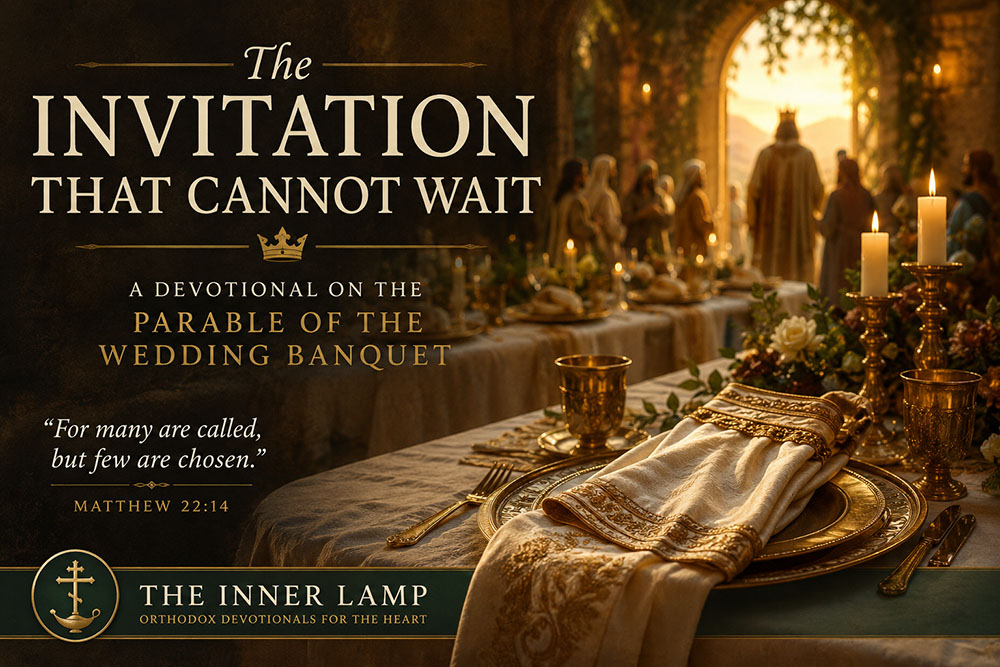
“The kingdom of heaven is like a certain king who arranged a marriage for his son.”
—Matthew 22:2 (NKJV)
A Living Introduction
Most invitations arrive with an expectation. A birthday party invites us to celebrate, a graduation invites us to honor an achievement, and a wedding invites us to witness joy.
Yet every invitation requires a response.
Some invitations are declined because of conflict. Others because of distance. Still others are forgotten beneath the weight of everyday life. Work needs attention. The lawn needs mowing. The errands pile up. Tomorrow always seems more convenient than today.
The tragedy is that we don’t always refuse what is important, but that we simply become distracted by what seems urgent.
In the Parable of the Wedding Banquet, Jesus tells the story of people who miss the greatest celebration imaginable—not because they hated the king, but because they had other plans.
Understanding the Parable
Jesus tells this parable during His final days in Jerusalem. The religious leaders have challenged His authority, and He responds with a series of parables exposing the danger of rejecting God’s call.
The image of a banquet would have been familiar to His listeners. Throughout the Old Testament, God’s kingdom is often portrayed as a great feast. The prophet Isaiah describes a future banquet prepared by the Lord for all peoples—a feast overflowing with abundance, joy, and life.
In Matthew’s account, the host is not merely a wealthy man. He is a king. The banquet is not an ordinary meal. It is a wedding feast for his son.
Everything about the story points beyond itself.
The king represents God.
The son points toward Christ.
The banquet points toward the kingdom.
The invitation is God’s gracious call to enter into communion with Him.
Yet those first invited refuse to come.
Some ignore the invitation altogether. Others become occupied with their businesses and possessions. Their rejection is not always violent; often it is simply indifferent.
The king then sends his servants into the streets to gather anyone willing to come. The hall is filled with people who never expected to sit at the king’s table.
The invitation is broader than anyone imagined.
Yet the parable concludes with a sobering image. One guest enters without a wedding garment and is cast out. The invitation was freely given, but participation in the feast required preparation.
The Inner Lamp
One of the most unsettling truths in this parable is that the invited guests were not enemies of the king.
They were simply preoccupied.
That should give us pause.
Most Christians do not wake up one morning determined to abandon Christ. The drift is usually far more subtle. Prayer becomes occasional. Worship becomes optional. Scripture remains unopened. The concerns of daily life slowly occupy the space once reserved for God.
The farm. The business.
The responsibilities. The distractions.
None of these things are evil in themselves.
The danger comes when good things become excuses for neglecting the One who invited us.
The kingdom is often missed not because of rebellion but because of distraction.
Yet the parable also offers extraordinary hope.
When they invited guests refuse, the king does not cancel the feast. He opens the doors wider.
Those from the roads and highways are welcomed in.
The forgotten, the overlooked, the outsider, the sinner.
Those who never imagined they belonged.
This is the heart of God. His desire is not exclusion but communion. His kingdom is not reserved for a privileged few. The invitation extends farther than we often realize.
Still, the wedding garment reminds us that grace is not merely an invitation to attend. It is an invitation to be transformed.
The Christian life is not simply about accepting Christ. It is about being clothed with Christ.
Through repentance, prayer, the Holy Mysteries, and a life of obedience, we are gradually dressed for the feast.
The guest without the garment wanted the banquet but not the transformation.
He desired the celebration without surrender.
The blessing without the change.
The kingdom does not work that way.
Christ welcomes us exactly as we are.
He does not leave us as we are.
A Voice from the Fathers
Saint Augustine saw the wedding garment as the life of charity—the visible evidence that God’s grace had taken root within the heart.
To enter the feast while refusing love is to wear no garment at all.
The invitation is freely given, but the Christian life is meant to bear fruit. Faith must become repentance. Repentance must become love. Love must become a way of life.
The garment is not something we weave for ourselves.
It is Christ Himself.
As Saint Paul writes:
“For as many of you as were baptized into Christ have put on Christ.” (Galatians 3:27)
Walking It Out Today
Ask yourself three questions:
- What distractions most often pull my attention away from God?
- Have I become comfortable receiving God’s gifts while resisting His transforming work?
- What step of obedience is Christ inviting me to take today?
The invitation still stands.
The banquet is being prepared.
The King is still calling.
The only question is how we will respond.
Prayer
Lord Jesus Christ, Heavenly Bridegroom, thank You for inviting me into Your kingdom. Forgive me for the times I have allowed the concerns of this world to overshadow Your call. Clothe me with repentance, humility, and love. Help me to set aside every excuse and respond to Your invitation with my whole heart. Prepare me for the great feast of Your kingdom, that I may rejoice forever in Your presence. Amen.
Questions for Reflection
- What “farm” or “business” most often distracts me from God?
- In what areas of my life am I resisting transformation?
- What does it mean to be clothed with Christ in my daily life?
- How can I become more attentive to God’s invitation this week?
- What hope do I find in knowing that God’s invitation extends even to the outsider and the broken?